> For the complete documentation index, see [llms.txt](https://chartschool.stockcharts.com/llms.txt). Markdown versions of documentation pages are available by appending `.md` to page URLs; this page is available as [Markdown](https://chartschool.stockcharts.com/table-of-contents/index-and-market-indicator-catalog/stockcharts-high-low-index.md).
# StockCharts High-Low Index
## Overview
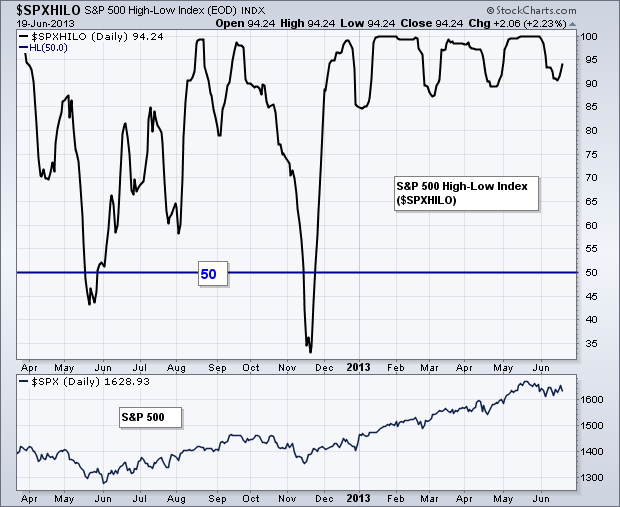
The StockCharts High-Low Index is a 10-day moving average of Record High Percent, which equals new 52-week highs divided by the sum of new 52-week highs plus new 52-week lows. This breadth indicator shows when new highs outnumber new lows and when new highs are expanding. In general, new highs outnumber new lows when the indicator is above 50. New highs are expanding when the indicator is above 50 and rising.
## Details
**Symbol Group:** High-Low Index
**Publisher:** StockCharts
**Update Frequency:** End-of-day (EOD). These indicators are updated after the market close, usually by 6:00 PM ET.
**Links to Current Symbols:** [High-Low Index](https://stockcharts.com/search/?q=%22High-Low%20Index%22\§ion=symbols)
## Data Characteristics
StockCharts uses a three-step process to calculate the High-Low Index for several stock indices. First, StockCharts maintains component lists for these indices. Second, our scan-engine uses these component lists to run scans based on the price data for the individual stocks. Third, the data is updated and published to our website.
This “in-house” data may differ from other sources due to differences in the index components and price data. Index components change and require updates on a regular basis. Additionally, note that StockCharts uses dividend-adjusted data for its calculations, while other sources may use non-adjusted data.
## Chart Example
The chart below shows the S\&P 500 High-Low Index ($SPXHILO) in the main window and the S\&P 500 in the indicator window. Notice how the High-Low Index held above 50 (and at a high level) when the S\&P 500 advanced, but the indicator moved below 50 during the two corrections.
High-Low Index
## Symbol List
StockCharts.com users can access [an up-to-date list of symbols](https://stockcharts.com/search/?q=%22High-Low%20Index%22\§ion=symbols) for all our High-Low Index indicators. From this list, click the “Mentions” icon to the right of a specific symbol for more details about the symbol, as well as recent mentions in Public ChartLists, blog articles, and more.
## Additional Resources
### ChartSchool Articles
[**High-Low Index**](/table-of-contents/market-indicators/high-low-index.md)\
The 10-day moving average of the Record High Percent Index, which is a breadth indicator.
---
# Agent Instructions
This documentation is published with GitBook. GitBook is the documentation platform designed so that both humans and AI agents can read, navigate, and reason over technical content effectively. Learn more at gitbook.com.
## Querying This Documentation
If you need additional information that is not directly available in this page, you can query the documentation by asking a question.
Perform an HTTP GET request on the following URL with the `ask` and `goal` query parameters:
```
GET https://chartschool.stockcharts.com/table-of-contents/index-and-market-indicator-catalog/stockcharts-high-low-index.md?ask=&goal=
```
`ask` is the immediate question: it should be specific, self-contained, and written in natural language.
`goal` is what the user is ultimately trying to achieve, the reason they need the answer. Sharing it helps GitBook give you a better, more relevant answer. A goal is most helpful when it describes the outcome the user wants rather than restating the question. For example, with `ask=how do I create an API token`, a goal like `automate deployments from our CI pipeline` lets GitBook tailor the answer to that use case.
The response will contain a direct answer to the question and relevant excerpts and sources from the documentation.
Use this mechanism when the answer is not explicitly present in the current page, you need clarification or additional context, or you want to retrieve related documentation sections.